PART I (1st Company) HERE
PART II (2nd Company) HERE
PART III (3rd Company) HERE
PART IV (4th Company) HERE
Please check this post for more notes and info regarding the Guardia Nazionale.
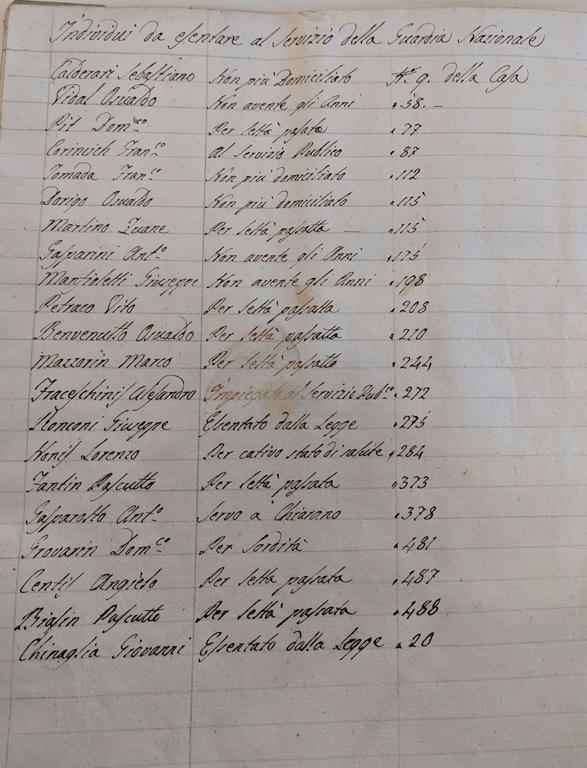
There was an extra page in the Guardia Nazionale register where they wrote all the individuals that were exempted from that particular military service.
They are the same that were already reported in part I to IV, but I suppose it was easier for them to have them all in one list.
Name - reason for exemption - house number.
You can look them up in part I to IV and find out where exactly they lived (hamlet is not given here) and the translations of the reason for exemption is in the notes/info post.
Individui da esentare al servizio della Guardia Nazionale
Calderari Sebastiano - Non più Domiciliato - N°9 della Casa
Vidal Osvaldo - Non avente gli Anni - N° 58
Pit Domenico - Per lettà pasata - N° 77
Corincich Francesco - Al Servizio Publico - N° 87
Tomada Francesco - Non più domiciliato - N° 112
Dorigo Osualdo - Non più domiciliato - N° 115
Martino Zuane - Per lettà passatta - N° 115
Gasparini Antonio - Non avente gli anni - N° 175
Manfioletti Giuseppe - Non avente gli anni - N° 198
Petracco Vito - Per lettà passatta - N° 208
Benvenutto Osualdo - Per lettà passatta - N° 210
Mazzorin Marco - Per lettà passatta - N° 244
Franceschinis Alesandro - Impiegato al Servizio Pubblico - N° 272
Ronconi Giuseppe -Esentato dalla legge - N°275
Nonis Lorenzo - Per cativo stato di salute - N° 284
Fantin Pascutto - Per lettà passata - Nç 373
Gasparotto Antonio - Servo a Chiarano - N° 378
Grovarin Domenico - Per sordità - N° 481
Centis Angielo - Per letta passata - N° 487
Biasin Pascutto - Per lettà passata - N° 488
Chinaglia Giovanni - Esentato dalla legge - N° 20
-- This project is now complete! --
Showing posts with label Napoleonic Era. Show all posts
Sunday, 27 October 2019
Sunday, 20 October 2019
"Guardia Nazionale" 1808 - Part IV (4th Company) [Municipal Archives]
PART I (1st Company) HERE
PART II (2nd Company) HERE
PART III (3rd Company) HERE
Please check this post for more notes and info regarding the Guardia Nazionale.
Column headers:
-N° = Progressive number
-Cognome e nome = Surname and name
-Contrada = See notes post for a map
-N° casa = house number (I believe that the missing numbers are the same as those in the previous line).
-Età = Age
-Professione - Occupation
-The last column had no header, it has notes and also some "x"s. It's possible those were added in subsequent years when the list was updated (possibly 1809-1810), instead of rewriting it entirely. In the third and forth part there are also dots and lines... I honestly have no idea what they mean.
Transcription of the list under the cut
PART II (2nd Company) HERE
PART III (3rd Company) HERE
Please check this post for more notes and info regarding the Guardia Nazionale.
Column headers:
-N° = Progressive number
-Cognome e nome = Surname and name
-Contrada = See notes post for a map
-N° casa = house number (I believe that the missing numbers are the same as those in the previous line).
-Età = Age
-Professione - Occupation
-The last column had no header, it has notes and also some "x"s. It's possible those were added in subsequent years when the list was updated (possibly 1809-1810), instead of rewriting it entirely. In the third and forth part there are also dots and lines... I honestly have no idea what they mean.
Transcription of the list under the cut
Sunday, 15 September 2019
"Guardia Nazionale" 1808 - Part III (3rd Company) [Municipal Archives]
PART I (1st Company) HERE
PART II (2nd Company) HERE
Please check this post for notes and info on the Guardia Nazionale.
Column headers:
-N° = Progressive number
-Cognome e nome = Surname and name
-Contrada = See notes post for a map
-N° casa = house number (I believe that the missing numbers are the same as those in the previous line).
-Età = Age
-Professione - Occupation
-The last column had no header, it has notes and also some "x"s. It's possible those were added in subsequent years when the list was updated (possibly 1809-1810), instead of rewriting it entirely. In this third part there are also dots and lines... I have no idea what they mean.
Check the notes post for the meaning of those phrases in the last column.
Transcription of the list under the cut
PART II (2nd Company) HERE
Please check this post for notes and info on the Guardia Nazionale.
Column headers:
-N° = Progressive number
-Cognome e nome = Surname and name
-Contrada = See notes post for a map
-N° casa = house number (I believe that the missing numbers are the same as those in the previous line).
-Età = Age
-Professione - Occupation
-The last column had no header, it has notes and also some "x"s. It's possible those were added in subsequent years when the list was updated (possibly 1809-1810), instead of rewriting it entirely. In this third part there are also dots and lines... I have no idea what they mean.
Check the notes post for the meaning of those phrases in the last column.
Transcription of the list under the cut
Saturday, 13 July 2019
"Guardia Nazionale" 1808 - Part II (2nd Company) [Municipal Archives]
Part II of our 4 parts series transcribing the 1808 list of citizens of San Vito (San Vito al Tagliamento, Pordenone) that were in the Guardia Nazionale (National Guard) when this town and many other parts of Italy were under French rule.
PART I (1st Company) HERE
Please check this post for notes and info on the Guardia Nazionale.
Column headers:
-N° = Progressive number
-Cognome e nome = Surname and name
-Contrada = See notes post for a map
-N° casa = house number (I believe that the missing numbers are the same as those in the previous line).
-Età = Age
-Professione - Occupation
-The last column had no header, it has notes and also some "x"s. It's possible those were added in subsequent years when the list was updated (possibly 1809-1810), instead of rewriting it entirely.
Check the notes post for the meaning of those phrases.
Transcription of the list under the cut
PART I (1st Company) HERE
Please check this post for notes and info on the Guardia Nazionale.
Column headers:
-N° = Progressive number
-Cognome e nome = Surname and name
-Contrada = See notes post for a map
-N° casa = house number (I believe that the missing numbers are the same as those in the previous line).
-Età = Age
-Professione - Occupation
-The last column had no header, it has notes and also some "x"s. It's possible those were added in subsequent years when the list was updated (possibly 1809-1810), instead of rewriting it entirely.
Check the notes post for the meaning of those phrases.
Transcription of the list under the cut
Sunday, 23 June 2019
"Guardia Nazionale" 1808 - Part I (1st Company) [Municipal Archives]
In the municipal archives of San Vito al Tagliamento there is a small book titled
"Ruolo
Degli Individui Componenti la Guardia Nazionale
1808"
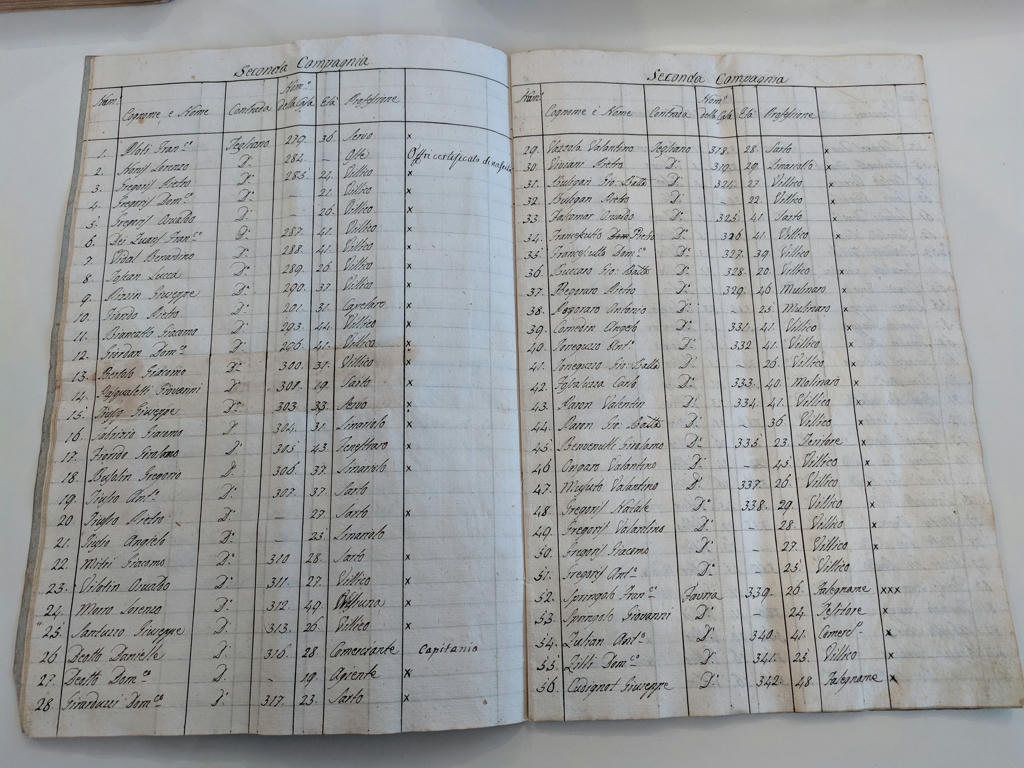
It is a list of the citizens that made up that town's branch of the Guardia Nazionale (National Guard) during the Napoleonic Era (in this case, 1808).Here's a page of the list:
I've transcribed it and it will be posted in 4 parts.
Please check the previous post with notes for these posts and info on the Guardia Nazionale.
Column headers:
-N° = Progressive number
-Cognome e nome = Surname and name
-Contrada = See notes post for a map
-N° casa = house number (I believe that the missing numbers are the same as those in the previous line).
-Età = Age
-Professione - Occupation
-The last column had no header, it has notes and also some "x"s. It's possible those were added in subsequent years when the list was updated (possibly 1809-1810), instead of rewriting it entirely.
Check the notes post for the meaning of those phrases.
Transcription of the list under the cut
Notes and info for the "Guardia Nazionale" posts
This post is for notes, maps and informations useful to understand the next 4 blog posts on the list of soldiers in the Guardia Nazionale (National Guard)
It will be updated when each post is published.
Posts
Part I - 1st Company HERE
Part II - 2nd Company HERE
Part III - 3rd Company HERE
Part IV - 4th Company HERE
Exempted individuals HERE
Info:
For an idea of the uniforms used during the Napoleonic times: here.
Description of the duties, the uniforms, the composition etc of the Guardia Nazionale (National Guard) during this period can be found in this book:
"Codice dei podestà e sindaci del Regno d'Italia" Milano, dalla Reale Stamperia, 1811
specifically pages 100-113.
Please check this book (available for free on google books at the link provided) for detailed info.
Below just a brief summary of the composition of the GN, as per that book.
- soldiers are able bodied citizens between the ages of 18 and 50
- towns must keep a register for the Guardia Nazionale containing names, surnames, ages, profession and address of soldiers. The register is amended every November.
Are exempt from any obligation towards the GN:
- the constitutional authorities, prefects, vice-prefects, town councilors and other officials that are not paid.
- church ministers
- those that make up the reserve army
- those living in that town briefly/studying there
- workers in weapon factories
- those declared unfit for military service and with an income of less than 500 lire of Milan
Are exempt from providing personal service:
- head of public offices demanding daily presence
- professors and teachers in public schools
- those declared unfit for military service: they must pay monthly taxes based on their income (with income of more than 500 lire of Milan).
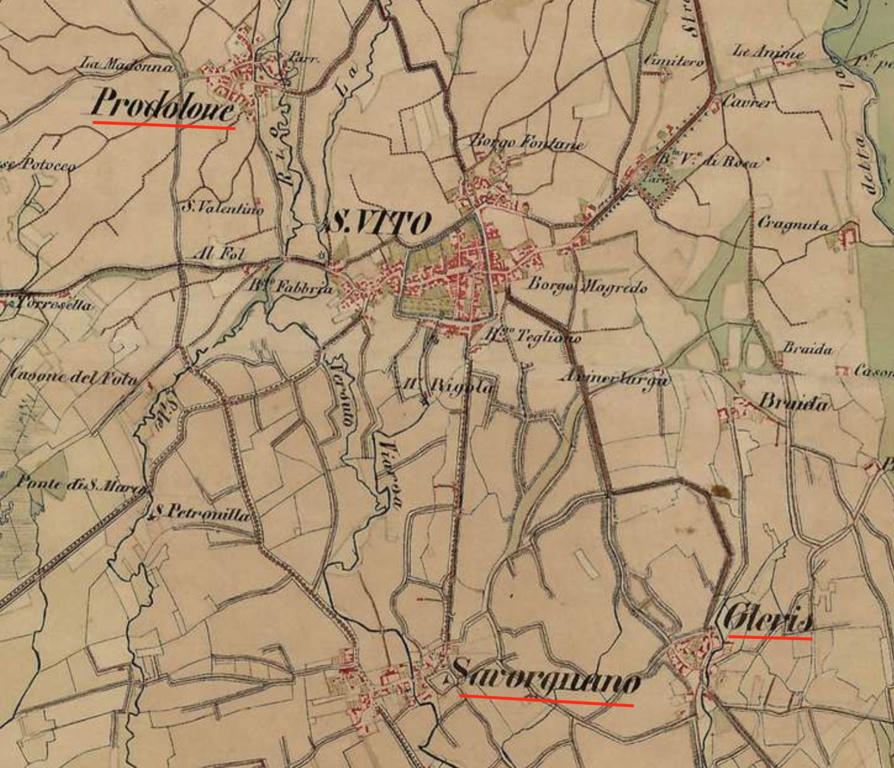
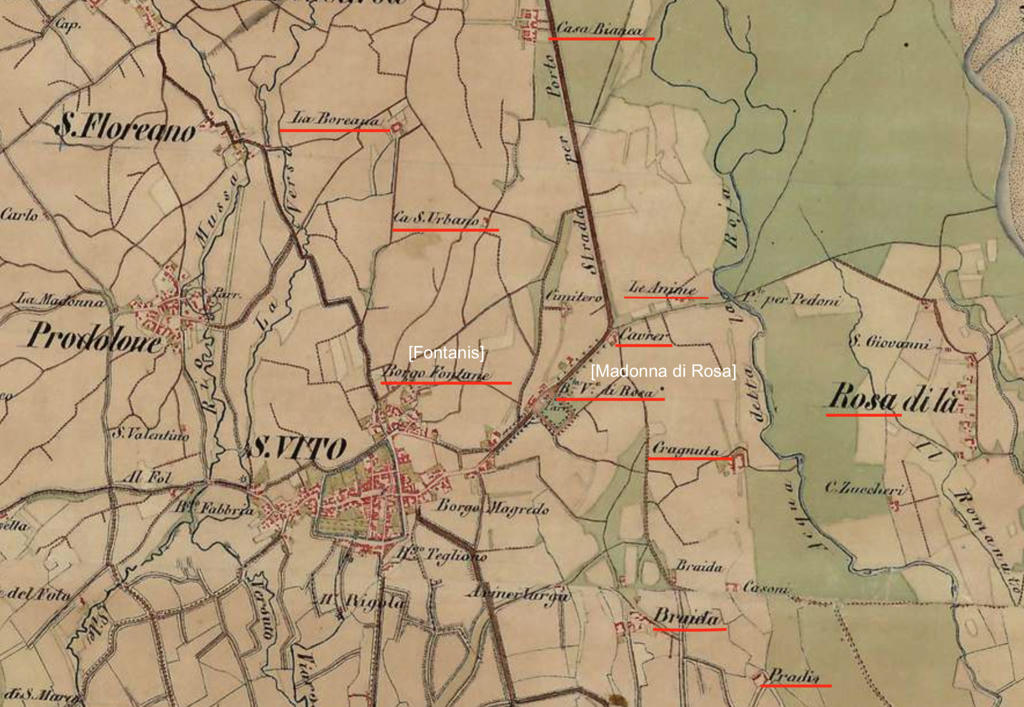
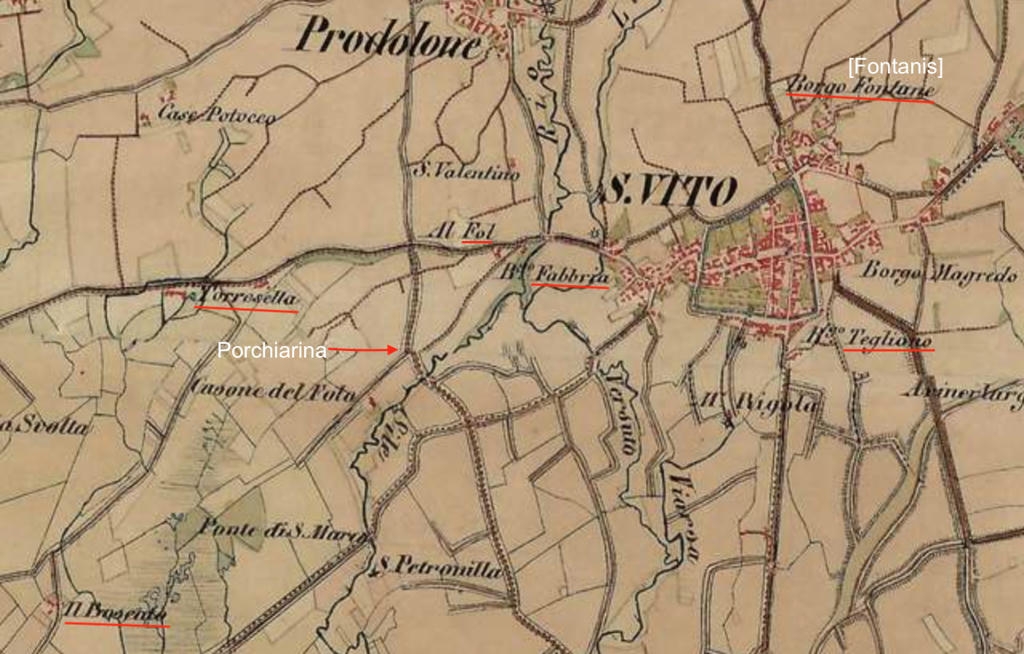
Maps:
San Vito represented on the second military survey of the Hapsburg Empire (1818-1829).
I have added the locations of the various "contrada" mentioned in the soldiers' lists, because only a couple were already in the map.
A "contrada" or "borgo" is smaller than a hamlet, it's usually made up by a few houses, sometimes it spans just half a street.
Contrade/Borghi for Post I:
Piazza - the public square
Levada - now Via (street) Roma, already Via 24 Luglio
Codamala - historically where the jewish community lived in the XVI century, now via Paolo Sarpi
Belveder - just outside the public square
(Borgo) della Madonna - near the church of S. Maria dei Battuti, now Via Bellunello
Castello - near where the old castle was (it became a noble residence that is now restored), now in Via G. Marconi
San Lorenzo - near the San Lorenzo church, outside the square but inside the largest of the city walls, in Via P. Amalteo
Savorgnana - the road leading to Savorgnano
(Borgo) Tegliano - where the hospital is, outside the city walls, now Piazzale Taliano.
(Borgo) Magredo - now Via A. L. Moro
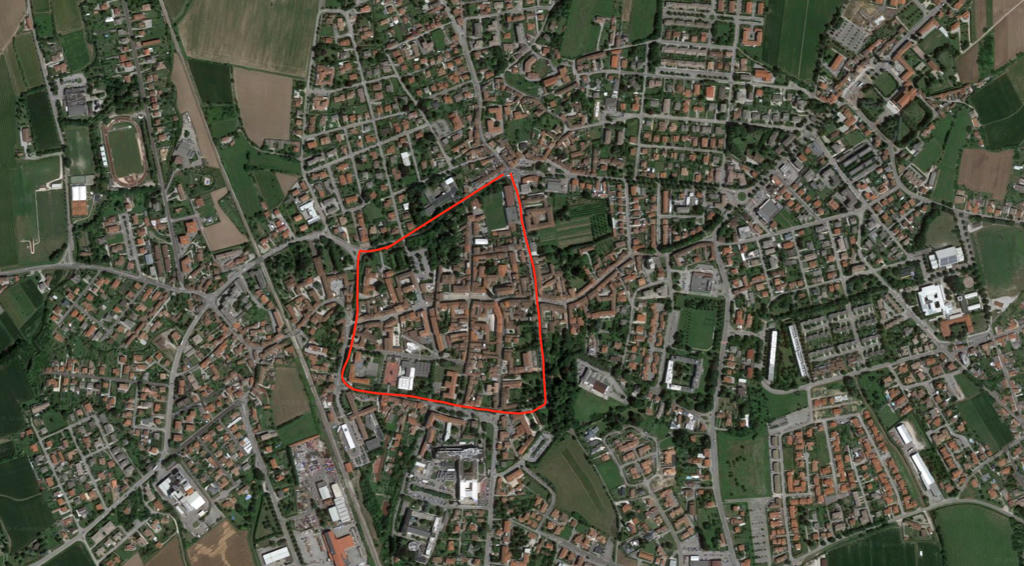
From Google maps today. I have used red to show where the Old Town is so that it's easy to spot where those locations are today.
Contrade/Borghi for Post II:
Tegliano - same as previous map
Favria (Fabbria)
Fol
Porchiarina
Boscato
Torisella/Toresella - Torricella
Fontanis
Contrade/Borghi for Post III:
Fontanis
Braida
Pradis
Ca' Bianca (Casa Bianca)
S. Urbano
Boreana
Madonna (di) Rosa
Cavrer - Capraio now
Anime
Cragnutto
di Rosa - Rosa
Contrade/Borghi for Post IV:
Prodolon - Prodolone
Savorgnan - Savorgnano
Gleris - Gleris
These are all current hamlets of San Vito.
Al servizio pubblico = Working for a public office
Capitanio = Captain
Capitano della 1a compagnia = Captain of the 1st Company
Capitano della 2a compagnia = Captain of the 2nd Company
Capitano della 4a compagnia = Captain of the 4th Company
Era infermo = He is an invalid
Esentato dalla legge = Exempted by law
Esentato per sordità = Exempted due to deafness
Impiegato al Off. di Leva = Employed at the conscription office
Impiegato al servizio pubblico = Public service employee
Non avente gli anni = Not yet of age [to serve]
Non più domiciliato = No longer living here
Offrì certificato di nascita = He showed birth certificate
Ora abita al n. 107 = Now living at n. 107
Ora abita a prodolon = Now living in Prodolone
Ora à età = Now of age
Ora non abita in paese = He's not living in this town now
Per cativo stato di salute = Not in good health
Per sordità = Because of deafness
Servo a Chiarano = Servant in Chiarano
Sorpasa l'età / Per lettà passata = Surpasses the [required] age
Sottotenente = Second lieutenant
Tenente della 1a compagnia = Lieutenant of the 1st Company
Thursday, 24 May 2018
On people with no surname, the 1813 Napoleonic Decree [Municipal Archives]
On June 11th, 1813, a Napoleonic decree stating dispositions on how to deal with people without a family name was published, these are the salient points:
1. Those living in the kingdom [of Italy] that do not have a surname or family name must adopt one and give a statement to the civil officer of the town where they reside within 3 months of this decree.
2. Foreigners coming to live in the kingdom and without a family name must do the same within 3 months of their arrival.
3. The family name that a father or other senior paternal ascendant adopt will be valid for all his children. In his statement the father or ascendant will mention all the children and descendants and where they live.
4. For minors without paternal ascendant, the statement will be given by their legal guardian.
5. Members of a family without living ascendant will choose a surname common to all of them, if they disagree the surname will be determined by the Mayor. Family members that are absent will comply with the decision taken.
6. Names of towns, forts and other places that are famous for battles or for other episodes of public and general interest will not be used as surnames.
7. Transgressors will be fined 100 lire and will be given a surname by the Mayor of the town they live in.
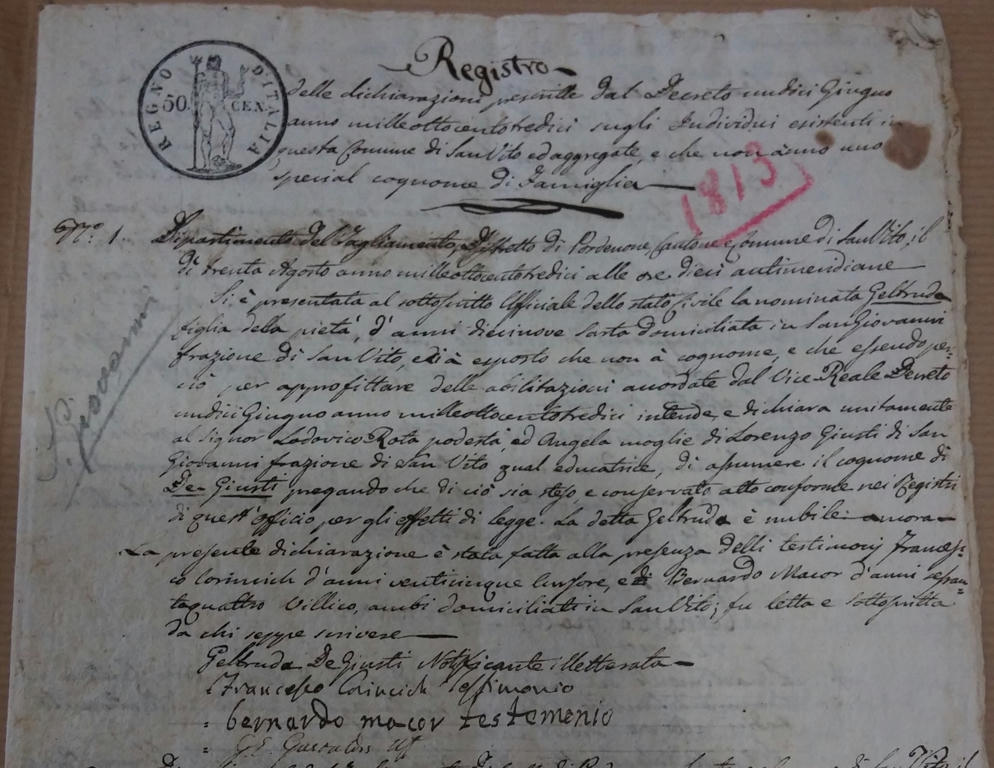
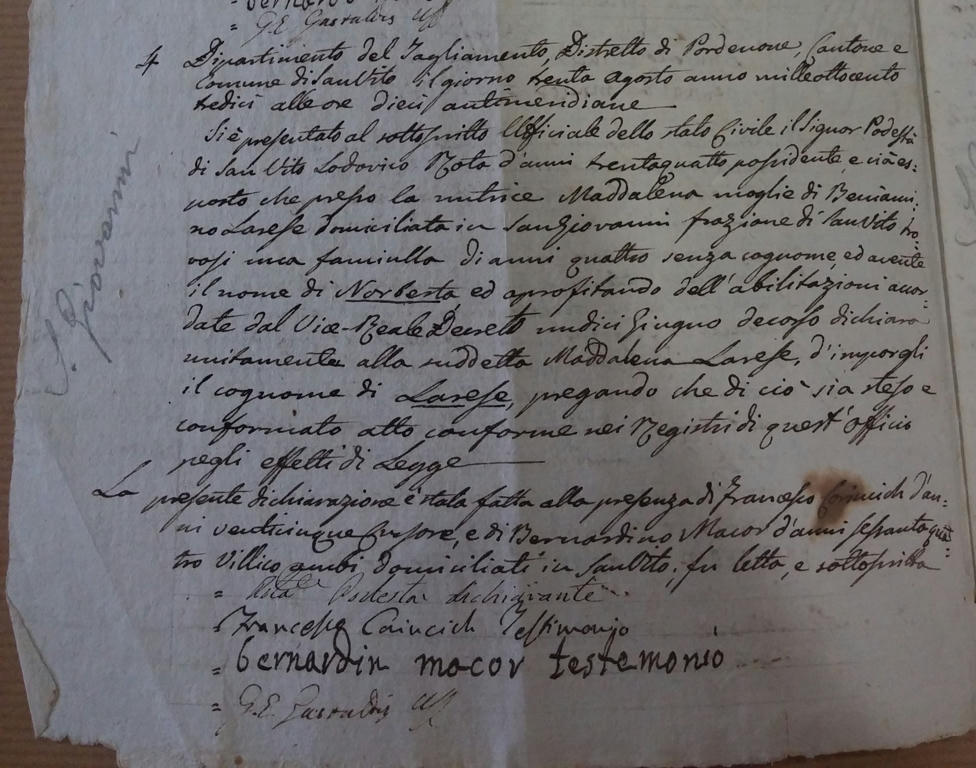
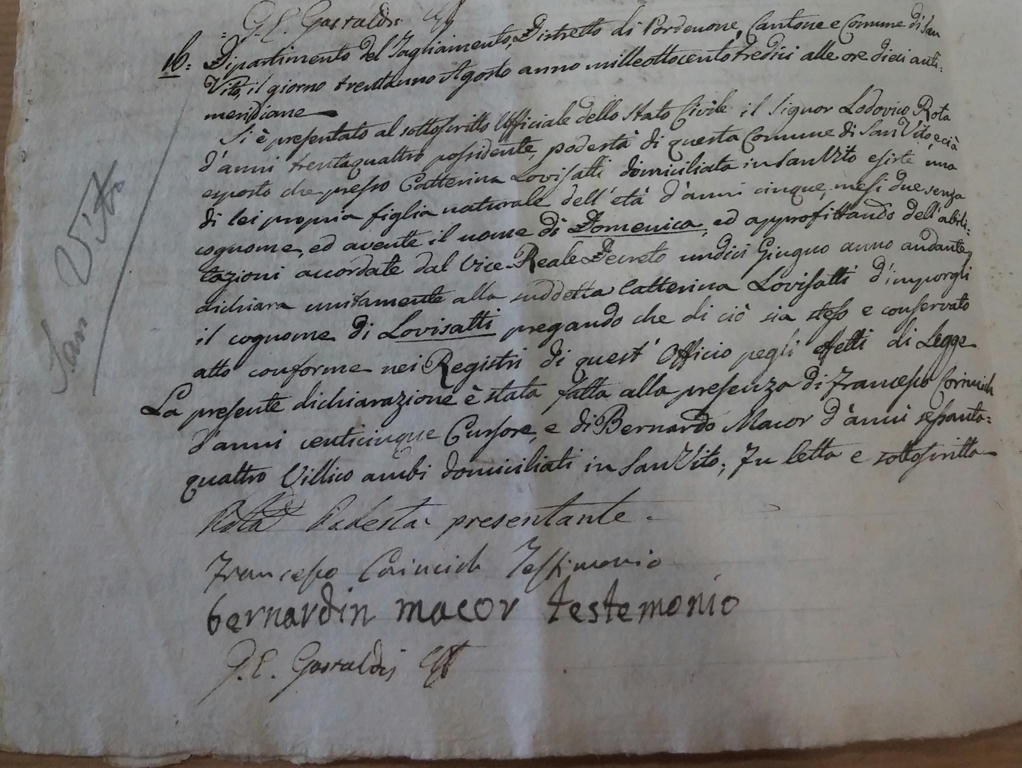
I have found in a Municipal Archive a few examples of these statements
In this first one the declarant is Geltrude "figlia della pietà" [the Pietà of Venice was an hospital founded in the XIV century that took in abandoned or very poor babies, and these children were usually known as "della Pietà or del luogo Pio di Venezia" on various documents. It almost acted as a surname, but it wasn't really. They were sent to other towns sometimes to be taken care of]. Geltrude is 19 years old and she declares, with the Mayor and Angela wife of Lorenzo Giusti, her tutor, that she wants to take the surname De Giusti.
Second example, the Mayor declares that in the house of the nurse [a wet nurse for the baby, probably] Maddalena wife of Beniamino Larese there's a 4 year-old girl named Norberta, and that she will be taking Larese as her surname.
Last one, the Mayor again declares that Caterina Lovisatti has a baby that is her own natural child. She's 5 years and 2 months old and named Domenica, but without a surname. They decided that the baby will take the surname Lovisatti.
Was this decree successful in getting rid this problem of not having a surname?
I'm sure it helped, but I noticed it was followed by other similar decrees during the Austrian rule and I noticed even in later years there were people called "della Pietà di Venezia" and similar, and so I think it wasn't, in the end.
1. Those living in the kingdom [of Italy] that do not have a surname or family name must adopt one and give a statement to the civil officer of the town where they reside within 3 months of this decree.
2. Foreigners coming to live in the kingdom and without a family name must do the same within 3 months of their arrival.
3. The family name that a father or other senior paternal ascendant adopt will be valid for all his children. In his statement the father or ascendant will mention all the children and descendants and where they live.
4. For minors without paternal ascendant, the statement will be given by their legal guardian.
5. Members of a family without living ascendant will choose a surname common to all of them, if they disagree the surname will be determined by the Mayor. Family members that are absent will comply with the decision taken.
6. Names of towns, forts and other places that are famous for battles or for other episodes of public and general interest will not be used as surnames.
7. Transgressors will be fined 100 lire and will be given a surname by the Mayor of the town they live in.
I have found in a Municipal Archive a few examples of these statements
In this first one the declarant is Geltrude "figlia della pietà" [the Pietà of Venice was an hospital founded in the XIV century that took in abandoned or very poor babies, and these children were usually known as "della Pietà or del luogo Pio di Venezia" on various documents. It almost acted as a surname, but it wasn't really. They were sent to other towns sometimes to be taken care of]. Geltrude is 19 years old and she declares, with the Mayor and Angela wife of Lorenzo Giusti, her tutor, that she wants to take the surname De Giusti.
Second example, the Mayor declares that in the house of the nurse [a wet nurse for the baby, probably] Maddalena wife of Beniamino Larese there's a 4 year-old girl named Norberta, and that she will be taking Larese as her surname.
Last one, the Mayor again declares that Caterina Lovisatti has a baby that is her own natural child. She's 5 years and 2 months old and named Domenica, but without a surname. They decided that the baby will take the surname Lovisatti.
Was this decree successful in getting rid this problem of not having a surname?
I'm sure it helped, but I noticed it was followed by other similar decrees during the Austrian rule and I noticed even in later years there were people called "della Pietà di Venezia" and similar, and so I think it wasn't, in the end.
Subscribe to:
Posts (Atom)