Showing posts with label Translation. Show all posts

Sunday, 12 March 2017

Understanding 1815-1871 Civil registrations [Deaths]

Previous blog posts on this topic:
Understanding 1815-1871 Civil registrations [Births] with introduction
Understanding 1815-1871 Civil registrations [Marriages]

Just as I did with the two previous posts I'm going to follow the same pattern for this last one.
The most interesting thing about these civil registrations is that they had a column for the cause of death, which is something that is rarely seen in Church books (actually, it depends on the parish and its priest, as always).
Another difference that I've often seen between these and the church registrations is that the civil ones mention, when it was known, the name of the mother (of the deceased).
I'm going to show you an example for one of my ancestors, for whom I have both the civil death registration and the burial notice from the church books, so we can see the difference in how they were written, but first we're going to analyze the columns headers and their meaning, like we did for births and marriages.

First page (left):
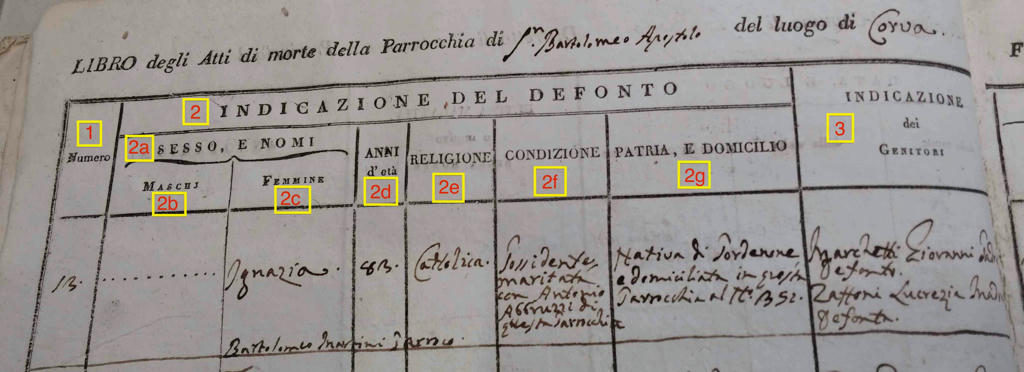
Parrocchia di S. Bartolomeo Apostolo, Corva (Azzano Decimo), Libro dei morti 1815-1871, Anno 1816 n. 13, Diocesi di Concordia-Pordenone, Archivio Storico, Pordenone

Italian:
1 - Numero
2 - Indicazione del defonto
2a - Sesso e nomi
2b - Maschi
2c - Femmine
2d - Anni d'età
2e - Religione
2f - Condizione
2g - Patria e domicilio
3 - Indicazione dei genitori

English:
1 - Number
2 - Informations about the deceased
2a - Sex and names
2b - Males
2c - Females
2d - Age
2e - Religion
2f - Condition
2g - Birthplace and domicile
3 - Informations about the parents

Let's translate this record (n. 13)
The deceased's name is [2c] Ignazia [surname Marchetti, see her father's below] and she was [2d] 83 years old and [2e] catholic, [2f] she was wealthy and married to a man named Antonio Abbruzzi who was from this [S. Bartolomeo] parish.
[2g] She was originally from Pordenone but was living in this parish at n. 351.
[3] Her parents were Marchetti Giovanni, father, deceased, and Zaffoni Lucrezia, mother, deceased.

The signature at the bottom of the registration is of the priest, "parroco" in italian, named Bartolomeo Martini.

Let's now look at the second page, the one on the right:
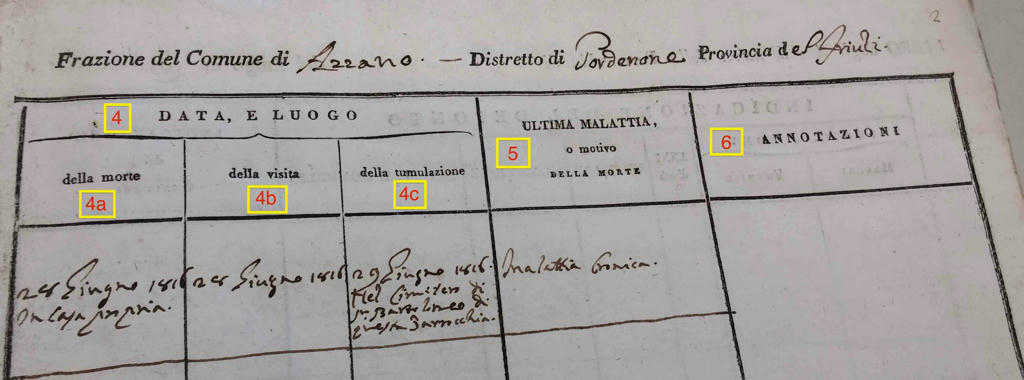
Parrocchia di S. Bartolomeo Apostolo, Corva (Azzano Decimo), Libro dei morti 1815-1871, Anno 1816 n. 13, Diocesi di Concordia-Pordenone, Archivio Storico, Pordenone

Italian:
4 - Data e luogo
4a - della morte
4b - della visita
4c - della tumulazione
5 - Ultima malattia, o motivo della morte
6 - Annotazioni

English:
4 - Date and place
4a - of the death
4b - of the visit [of the doctor or priest]
4c - of the burial
5 - Last illness, or cause of death
6 - Notes

So, poor Ignazia [4a] died on the 28th of June 1816 in her own house, [4b] was visited on the same day and [4c] buried the next day, 29th of June 1816, in the cemetery of S. Bartolomeo of the same parish.
[5] She died of some sort of chronic illness.

Now, as I promised, I'm going to translate the burial notice found in the church books for the same person, and written by the same priest, Bartolomeo Martini, so we can see what's missing.
Parrocchia di S. Bartolomeo di Corva, Registro dei Morti (1696-1897), Sepoltura del 29 giugno 1816 per Marchetti Ignazia, Diocesi di Concordia-Pordenone, Archivio storico diocesano, Pordenone

29th of June 1816
Mrs. Ignazia, daugter of the deceased Giovanni Marchetti from Pordenone, and wife of Mr. Antonio Abbruzzi of this parish, aged 83, having received the holy Sacraments of Penance, Eucharist, Extreme Unction [Final Anointing], the pontifical blessing, the absolution of the Holy Rosary, yesterday, at about 8pm, passed away, and today her dead body was buried in this Cemetery, with my assistance, Bartolomeo Martini, priest.

I want to stress once again the fact that in the Church books the emphasis was on the Sacraments, the following of the rites and the burial, not on how one died, at what age and who were the parents. In this specific document, out of 14 lines, 5 are dedicated to the listing of the Sacraments she had received.
The priest, every once in a while, had to show these books to his bishop, proving he was doing his job well, that he was caring for the people's soul and performing the correct rites.
That's why this document is missing some of the data we have in the previous one, like condition, domicile, mother's name and cause of death. As always, depending on the parish and the priest, what was there and what was missing can vary.

I think this is all I had to say about this type of records, I hope it was interesting and helpful!

Friday, 24 February 2017

Understanding 1815-1871 Civil registrations [Marriages]

Refer to the previous blog post for a brief explanations on this type of registers.

I'm just going to do the same for the Marriage Registers, transcribing and translating the column headers and an example.

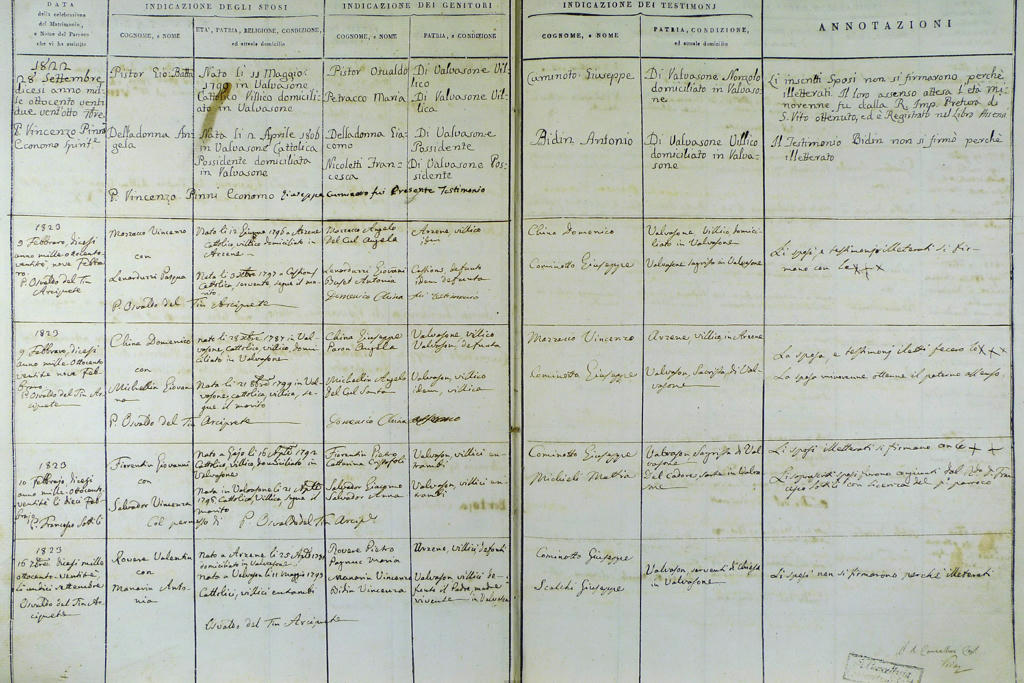
This is the a typical page of one of these books:
Parrocchia di Valvasone, Libro dei Matrimoni 1815-1863, copia digitale, pg. 25-26, Diocesi di Concordia-Pordenone, Archivio Storico, Pordenone

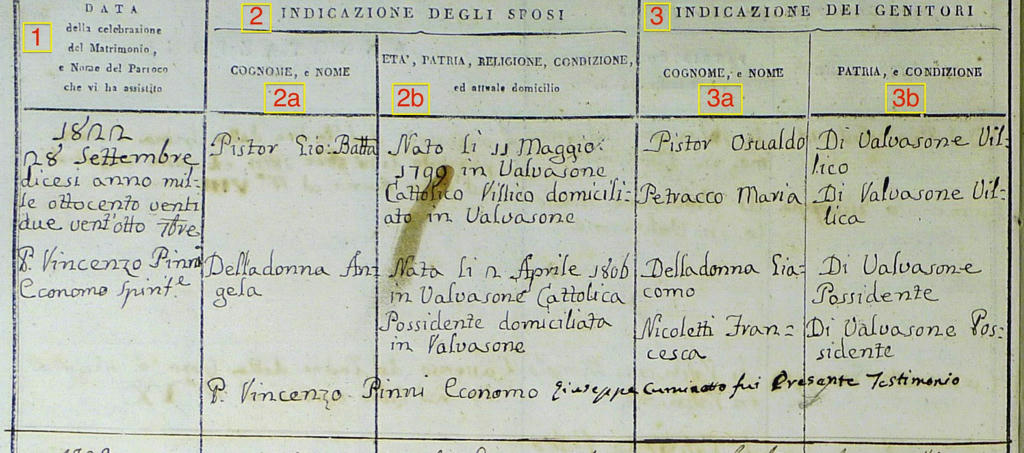
Zooming into the headers, on the left page we find:
Parrocchia di Valvasone, Libro dei Matrimoni 1815-1863, copia digitale, pg. 25, Diocesi di Concordia-Pordenone, Archivio Storico, Pordenone

Italian:
1- Data della celebrazione del matrimonio, e nome del Parroco che vi ha assistito
2- Indicazione degli sposi
2a- Cognome, e nome
2b- Età, patria, religione, condizione ed attuale domicilio
3- Indicazione dei genitori
3a- Cognome, e nome
3b- Patria, e condizione

English:
1- Date of the marriage and name of the priest who celebrated it
2- Informations about the groom and bride
2a- Surname and name
2b- Age, birthplace, religion, condition and actual domicile
3- Informations about the parents
3a- Surname and name
3b- Birthplace and condition

Some notes:

Sometimes, before N.1 there's another column with a progressive number.
Re 2b: Usually instead of the age we find the exact birthdate (see example).
Re 3b: Don't take the birthplace for the parents as a fact, because oftentimes it was just their town of residence.

So let's translate the left page of the marriage we see in that page, keeping in mind that you have to mentally divide (horizontally) the informations about the groom and the bride, that are written in the same row following their names.:
[Column 1] 1822, 28th of September [then they write it down in letters], Father Vincenzo Pinni.
[Column 2a] Pistor Gio Batta [groom] and Delladonna Angela [bride].
[Column 2b, top] He was born on the 11th of May 1799 in Valvasone, Catholic, Farmer, living in Valvasone, [column 3a and 3b, top] son of Pistor Osvaldo farmer from Valvasone and Petracco Maria farmer from Valvasone.
[Column 2b, bottom] She was born on the 2nd of April 1806 in Valvasone, Wealthy, living in Valvasone, [column 3a and 3b, bottom] daughter of Delladonna Giacomo, wealthy of Valvasone, and Nicoletti Francesca, wealthy of Valvasone.
[the line of names at the bottom are the priest and witness signatures]

I've translated the term "possidente" as "wealthy", it literally means "owner (of something)", but we don't know if it was land, a shop or what, although it often was land so it can be translated as landowner.

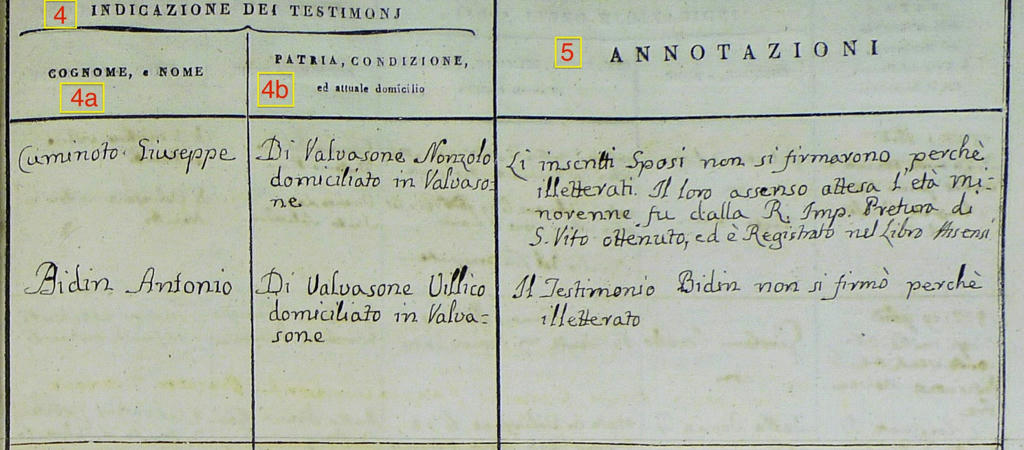
Let's do the same with the second page:
Parrocchia di Valvasone, Libro dei Matrimoni 1815-1863, copia digitale, pg. 26, Diocesi di Concordia-Pordenone, Archivio Storico, Pordenone
Italian:
4- Indicazione dei Testimonj
4a- Cognome, e nome
4b- Patria, condizione ed attuale domicilio
5-Annotazioni

English:
4- Informations about the witnesses
4a- Surname and name
4b- Birthplace, condition and domicile
5- Notes

For this marriage, the witnesses were Cominoto Giuseppe, from Valvasone, sacristan, and Bidin Antonio, farmer, from Valvasone.
In the notes section it's written that bride and groom had not signed because they were illiterate, and that because they were minors they had obtained permission to get married. The witness Bidin Antonio was also illiterate and had not signed.

In the notes sections most often the priest simply recorded that the newlyweds or the witnesses were illiterate, but also that the couple had been dispensed from banns, or that they had received permission to marry from the bishop because they were cousins.

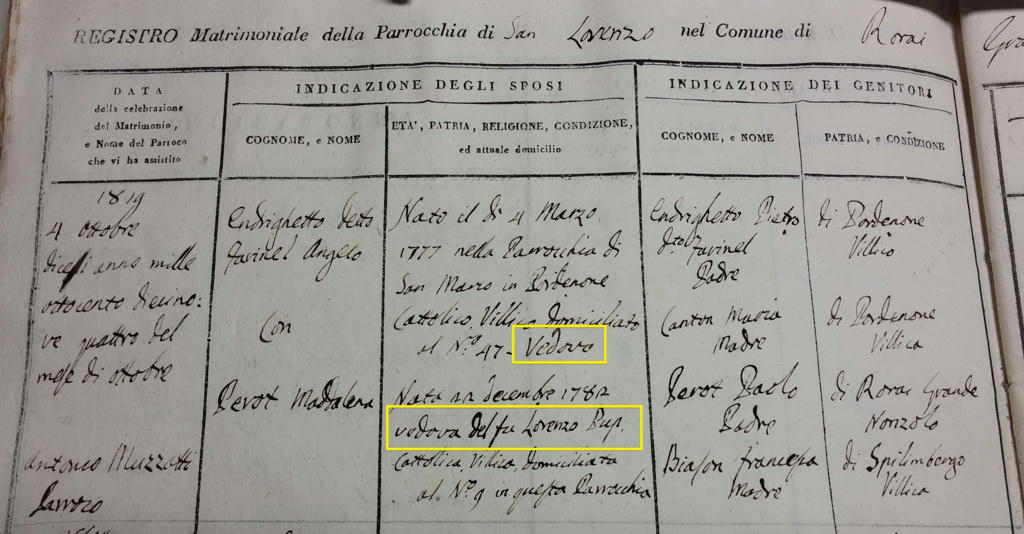
If one (or both) the newlyweds were widowed you may find it specified in column 2b, sometimes the name of the previous wife/husband is also recorded there.
See:
Parrocchia di San Lorenzo (Rorai Grande), Registro Matrimoniale 1815-1871, matrimonio del 4 ottobre 1819, p. sinistra, Diocesi di Concordia-Pordenone, Archivio Storico, Pordenone

In this case, both groom and bride were widowed, but for the groom we only have the word "vedovo", which means "widower", while for the bride we read "vedova del fu Lorenzo Pup" that translates to "widow of the deceased Lorenzo Pup", so we know her first (maybe!) husband's name.

I hope this helps!
The next one will be about death registers.

Sunday, 19 February 2017

Understanding 1815-1871 Civil registrations [Births]

After the brief experience under French rule (about 1806-1815) when it was part of the Kingdom of Italy, Friuli was subsequently ruled by the Austrian Empire and was part of it as province of the Kingdom of Lombardy-Venetia.
Province LombVeneto2.jpg
Provinces of the Kingdom (wikipedia)

During this period, starting around 1815 and ending as late as august 1871 (in september unified Italian Civil Registrations officially began everywhere), the Austrian government decided that their Civil Registry Offices would be located at the various parishes. So in those years the priest was required to record sacraments on its Church Books, and also to record birth, marriages and deaths on the big pre-printed sheets (or books) that I’m going to show later on.
The most important thing to notice is that, because they were pre-printed and the priest (or an assistant) had to simply fill in the text following the headers’ instructions, these records usually have lots more informations than those equivalent in the Church books.
If you’re looking for births, deaths or marriages that occurred during this period (and in these regions), always think to look in these registers first, if they still exist. If they don’t, then try with the church books.

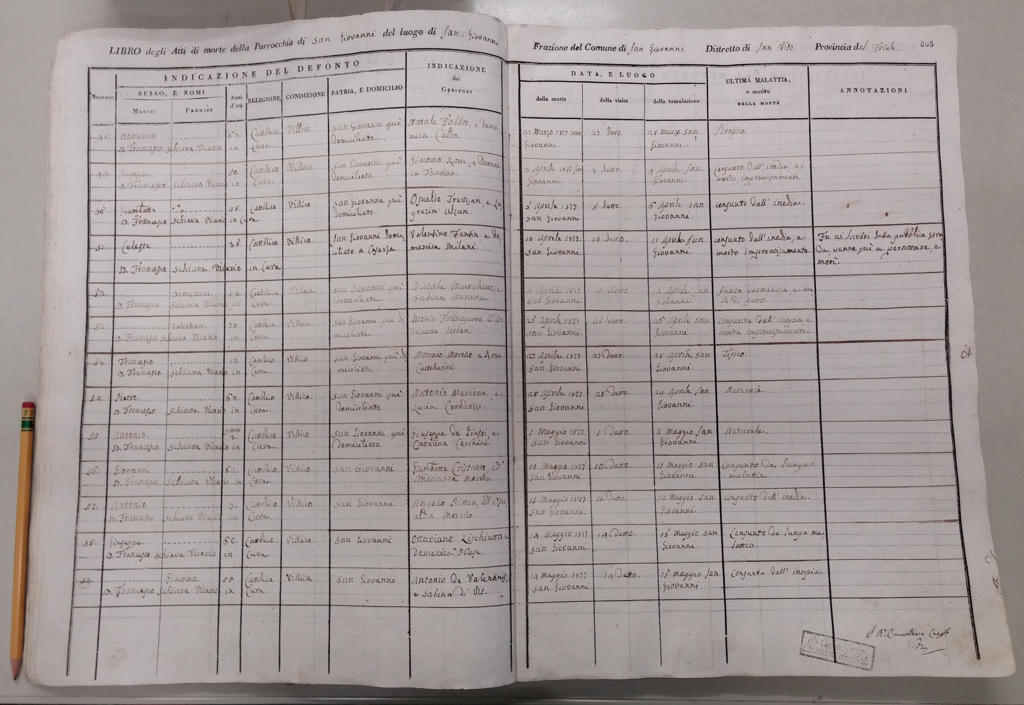
This is a picture I’ve taken of one of these big books, with a normal-sized pencil on the left, for scale.
The registrations span both pages, the rows are usually divided by lines but not always.
They are kept by the parish or by the competent Diocesan Archive.

Parrocchia di San Giovanni di Casarsa, Registro Morti, 1816-1842 sep. 23, pages 4-5, Diocesi di Concordia-Pordenone, Archivio Storico, Pordenone

These books have different column headers depending on what they were for, but all of them had this text on top of the pages:
Libro degli Atti di Morte [or Nascita, or Matrimonio] della parrocchia di [blank] del luogo di [blank] Frazione del comune di [blank] Distretto di [blank] Provincia [blank]
Book of Death Certificates [or Birth, or Marriages] for the parish of [blank] in [blank] Hamlet of the Commune of [blank] District of [blank] Province [blank]

Today I’m going to explain and translate the column headings for the births.

Let’s start with page left:
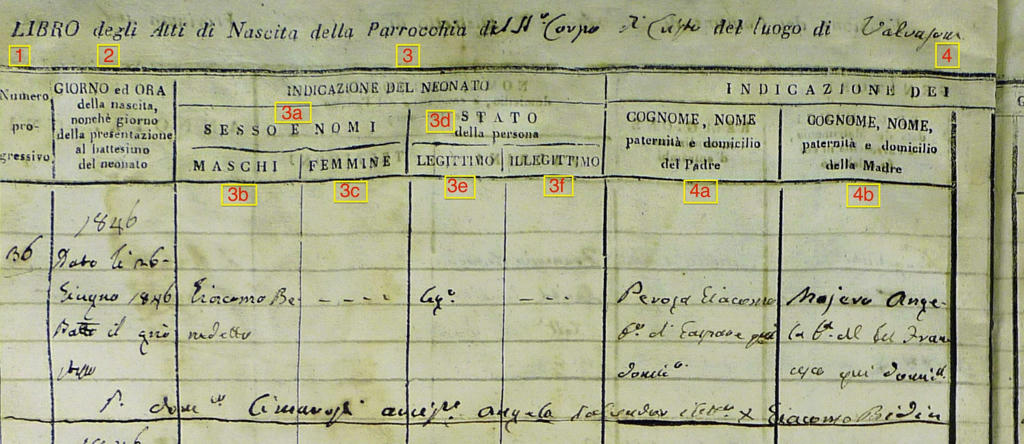
Look at the page and then refer to the red numbers and letters I’ve written:

Parrocchia di Valvasone, Libro dei Nati 1846-1853, page 39, n. 36, digital copy, Diocesi di Concordia-Pordenone, Archivio Storico, Pordenone

Italian:
1 - Numero progressivo
2 - Giorno ed ora della nascita, nonché giorno della presentazione al battesimo del neonato
3 - Indicazioni del neonato
3a - Sesso e nomi
3b - Maschi
3c - Femmine
3d - Stato della persona
3e - Legittimo
3f - Illegittimo
4 - Indicazioni dei Genitori (continues right page)
4a - Cognome, Nome, paternità e domicilio del Padre
4b - Cognome, Nome, paternità e domicilio della Madre

English:
1 - Progressive number
2 - Day and time of the birth, as well as day of the baptism of the baby
3 - Informations about the baby
3a - sex and names
3b - Males
3c - Females
3d - Condition of the person
3e - Legitimate
3f - Illegitimate
4 - Informations about the parents (continues on the right page)
4a - Surname, Name, Paternity and domicile of the Father
4b - Surname, Name, Paternity and domicile of the Mother

NB: In earlier books it's possible that 4a and 4b are switched, so you'll find the mother mentioned first while the father is on the next column.

If you look at the baby born in that page at number 36, this is his birth info (page left only)
Number 36 - 26th June 1846, bapt. same day, Giacomo Benedetto, legitimate, son of Perosa Giacomo son of Gaspare, living here [Valvasone], and of Majero Angela daughter of the deceased Francesco, living here.
[Perosa is the surname, Giacomo Benedetto is first and middle name.]

NB: Sometimes in the column for the baby's name (3b or 3c depending on the sex) they also repeat the surname, otherwise you infer it from the father's column.

Unless the person writing was lazy or didn’t know, we should always find the mothers’ maiden names and the names of paternal and maternal grandfathers.

Now let’s look at the right page and do the same:

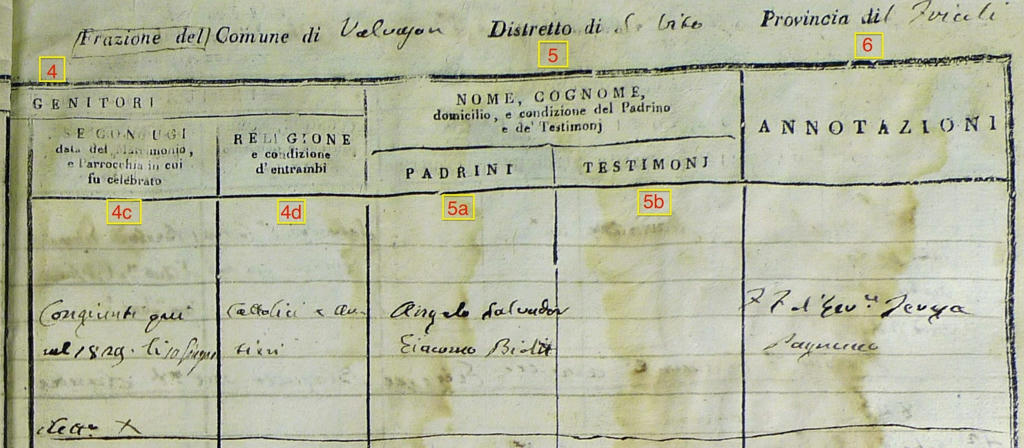
Parrocchia di Valvasone, Libro dei Nati 1846-1853, page 40, n. 36, digital copy, Diocesi di Concordia-Pordenone, Archivio Storico, Pordenone
Italian:
4 - Indicazione dei genitori (continues from left page)
4c - Se coniugi data dei Matrimonio, e parrocchia in cui fu celebrato
4d - Religione e condizione di entrambi
5 - Nome, Cognome, domicilio, e condizione del Padrino e de’ Testimonj
5a - Padrini
5b - Testimonj
6 - Annotazioni

English:
4 - Informations about the parents (continuing from the left page)
4c - If married, date and parish of marriage
4d - Religion and condition of both
5 - Name, Surname, domicile and condition of Godfather and Witnesses
5a - Godfathers
5b - Witnesses
6 - Notes

Continuing with n. 36, Giacomo Benedetto’s birth, his parents were married in that same parish (of Valvasone) on the 10th of June 1829, were Catholics and [can’t make out their profession]. Godfathers were Angelo Salvador and Giacomo Biotti, in the notes column the name of the midwife, Teresa Pagnacco, is recorded.
Notice that this writer did not follow the instructions literally, as he neglected to mention the godfather’s condition and domicile, and there were no witnesses.

Sometimes in the notes column you'll find interesting speculations or reports about the baby's paternity, especially when he/she was illegitimate, or when the dates of marriage of the parents were too close to the birth. In other cases it was recorded that the midwife had already baptized the newborn because she felt he/she was going to die and there wasn't time to call a priest.

I hope this is clear!

Next blog post: Marriages